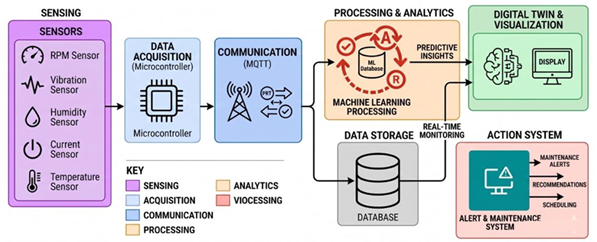
A live digital twin of an industrial induction motor: ESP32 sensors stream telemetry over MQTT into an ML pipeline that detects anomalies, classifies faults, scores health, and estimates Remaining Useful Life — visualized on a real-time dashboard with end-to-end latency under 500ms.
Industrial motors fail expensively and rarely announce it first. Scheduled maintenance wastes money servicing healthy machines; reactive maintenance means downtime. Predictive maintenance — catching degradation in the sensor signature before failure — is the Industry 4.0 answer, and a digital twin makes that prediction visible and actionable.
An ESP32 acquires vibration, temperature and current telemetry from the motor and publishes over MQTT; a Flask backend ingests the stream and runs a multi-layer ML pipeline — Isolation Forest for anomaly detection, XGBoost for fault classification — producing a health score, fault type, maintenance recommendation, and an RUL estimate served over REST to the live dashboard. Training data: physics-based synthetic datasets generated in MATLAB, covering fault modes too risky or slow to induce on real hardware.
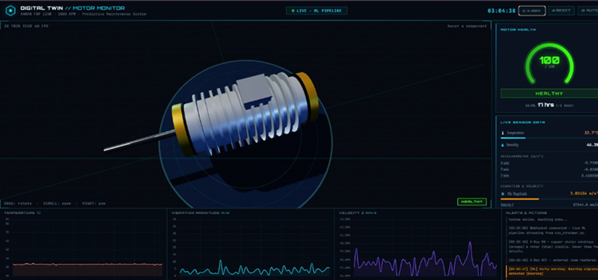
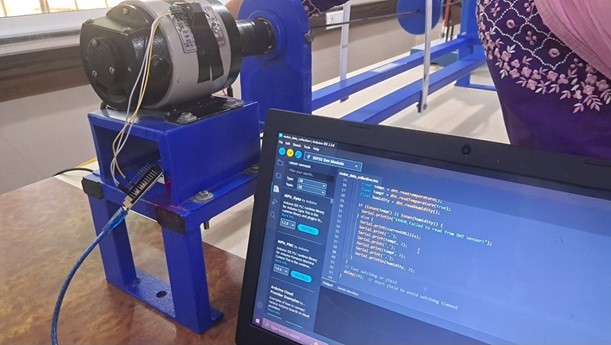
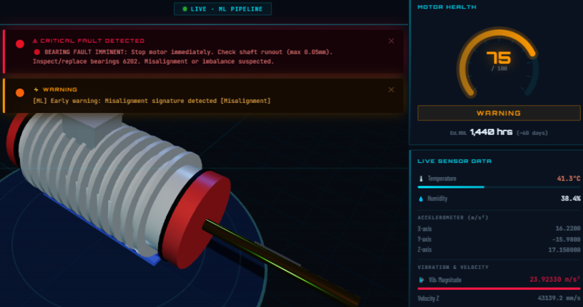
The fault-detection pipeline reaches 94% precision and 92% F1 across fault classes, with the full sensor-to-dashboard loop under 500ms — fast enough for operators to see the twin as "live."
Stated plainly, as always: these numbers are on synthetic MATLAB data. That's the right starting point for fault modes you can't safely produce on demand, but the model hasn't yet proven itself on months of real degradation. Closing that gap — accumulating real run-to-failure telemetry from the rig — is exactly what the remaining project timeline (through 2026) is for. Ranking it last among my six projects for that reason is the portfolio working as intended.
The model is a fraction of the work; the acquisition loop, the messaging layer, the latency budget and the visualization are what make it a twin instead of a chart.
It bought coverage of dangerous fault modes — as long as you say so and plan the path to real-world validation.